The Conductors of an Intelligent Orchestra
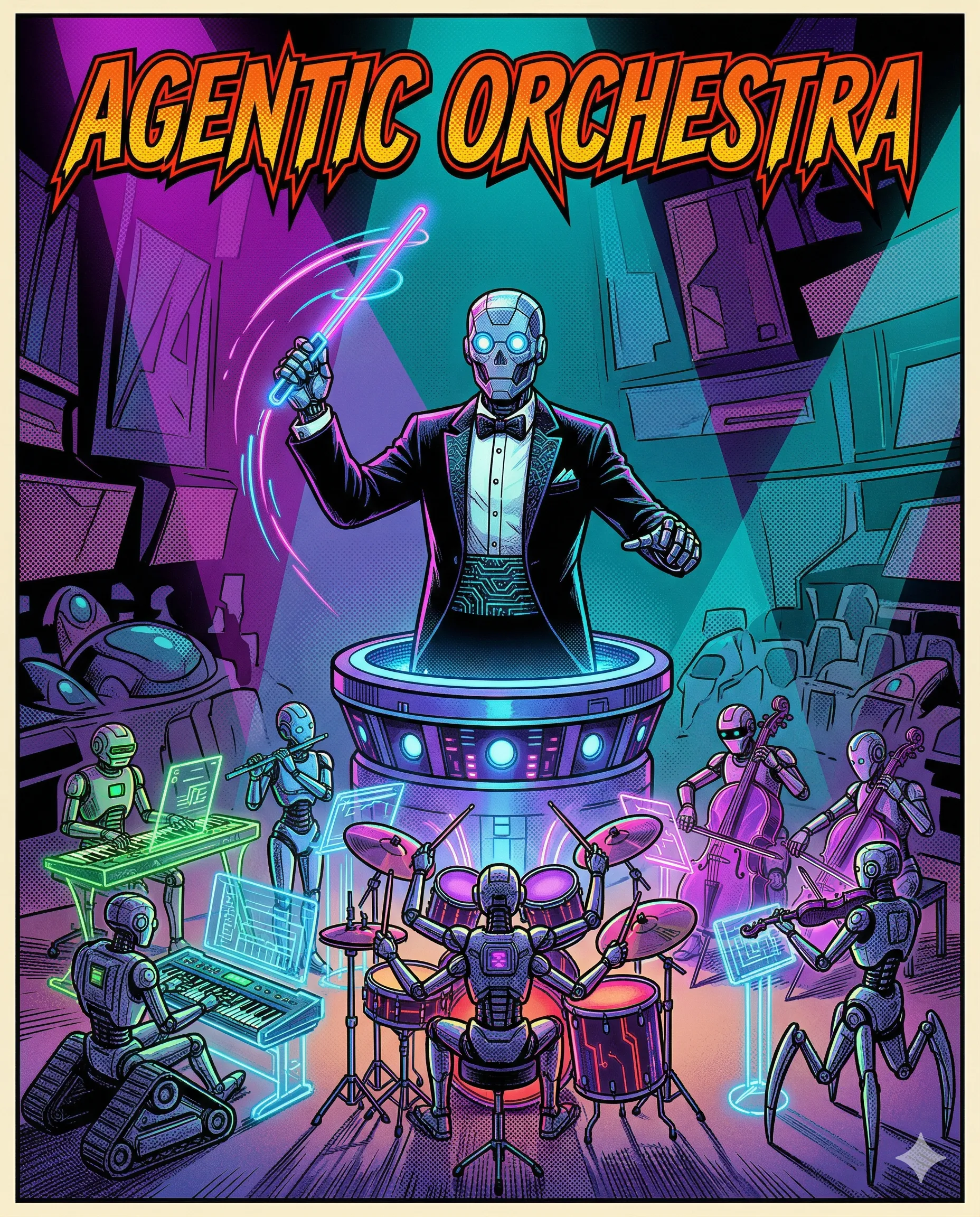
Imagine you are standing in front of a world-class orchestra. Each musician is a specialist—the violinist plays with soul, the drummer keeps the perfect rhythm, and the flutist adds the delicate details. To create a masterpiece, they need a conductor. The conductor doesn’t play a single instrument; instead, they hold the baton and ensure that every specialist starts and stops at the exact right moment.
This harmony is the future of advanced AI systems.
When you move beyond simple tasks, you stop using a single “Generalist AI” for everything. Instead, you build a team of “Multi-Agent Workflows.” You have one AI agent acting as the “Researcher” to gather data, another as the “Analyst” to find patterns, and a third as the “Editor” to polish the results. These agents talk to each other, passing the “Baton” of information back and forth until the final symphony is perfect.
The mechanism behind this is “Agentic Orchestration.” We provide a central “Orchestrator” model that manages the hand-offs between specialists. The orchestrator receives your request, breaks it into a sequence of smaller tasks, and assigns each task to the best-suited agent. This creates a “Connected Intelligence” where the strengths of each model are combined, while any single point of failure is easily caught by the team.
In practice, this allows you to complete weeks of work in minutes. For example, a market research firm uses an “AI Orchestra” to create a competitive analysis. The “Researcher Agent” scans the latest news, the “Number-Cruncher Agent” calculates market shares, and the “Writer Agent” drafts the executive summary. The “Fact-Checker Agent” then verifies every claim. Because they work as a team, the final report is deep, accurate, and ready for the boardroom.
Success happens when the individual parts vanish into a single, beautiful performance. You transition from “using a tool” to “leading a team.”
The Takeaway: a powerful AI system works like an orchestra, where specialized agents perform together under a single baton.
Why This Matters for Your AI Product
Multi-agent design is the peak of current AI architecture:
- Modular Scaling: Instead of one massive prompt that breaks easily, you have small, focused agents. You can swap the “Researcher” or “Analyst” without rebuilding the whole system.
- Improved Accuracy: When agents review each other’s work (the “Collaborative Critique” pattern), the hallucination rate drops significantly compared to single-shot responses.
- Complex Problem Solving: Orchestration allows your product to handle multi-step reasoning that is impossible for a single model, like planning a month of social media content and generating every asset.
AI specialists call it: Multi-agent Workflows A design pattern where multiple autonomous AI agents interact and collaborate to achieve complex goals through specialized roles.
If you were the conductor of an AI orchestra today, which three “musicians” would you want on your stage?
Part 17 of 18 | #RAGforHumans