The Master Filter: Why AI Needs a Specialized Critic
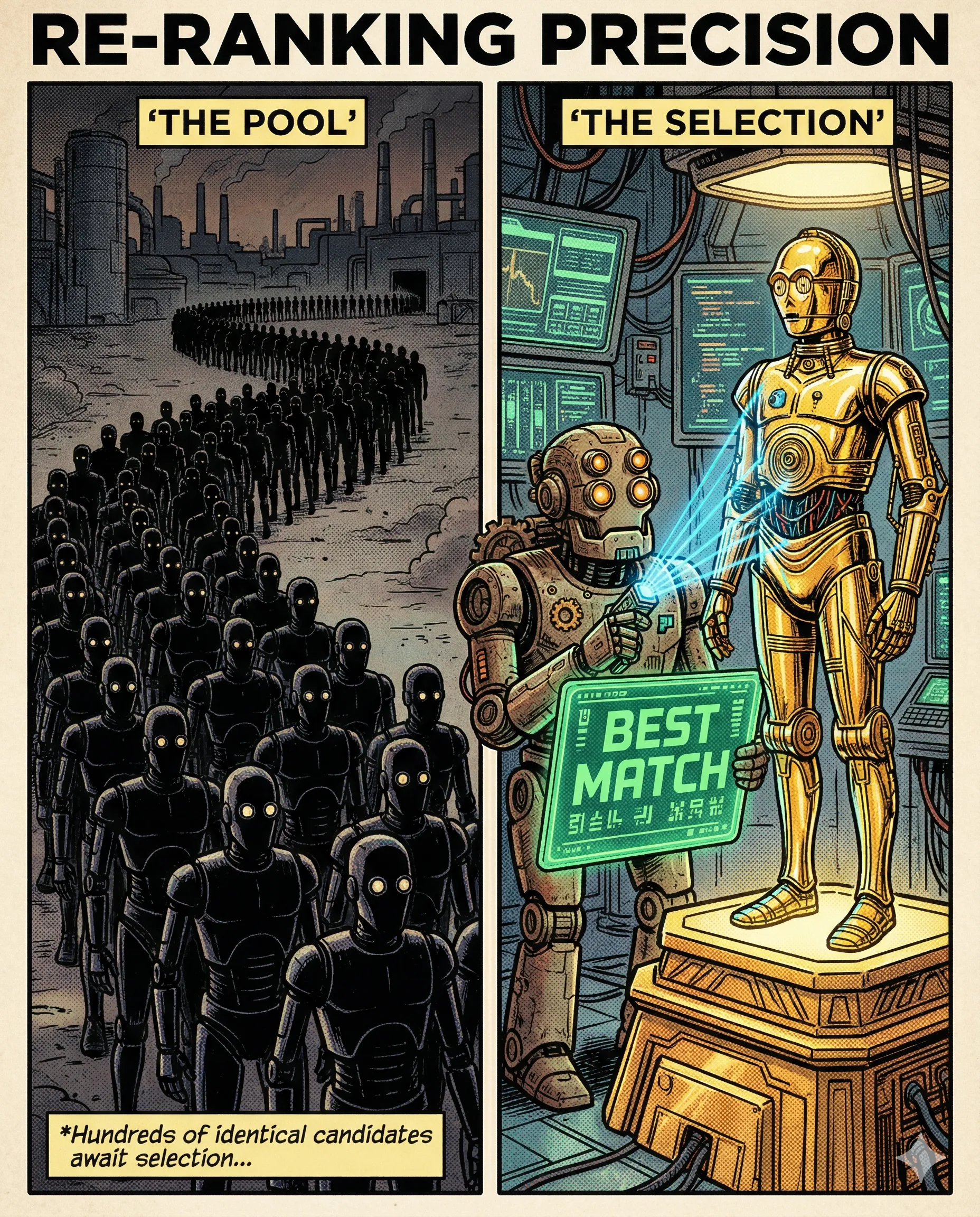
Imagine you are a director casting a lead role for a major sci-fi movie. For the first round, you see 1,000 actors in a single day. You spend only five seconds on each person to check if they have the right “look.” This is your “Fast Filter.” Out of those 1,000, you pick the best 10 for a “Deep Audition”—a long, detailed interview where you test their actual talent. Because you focus your time only on the top candidates, you find the perfect star for your film every time.
This two-step process is the secret to high-precision AI.
When your AI “Librarian” searches through a million documents (Vector Search), it is incredibly fast, but it can be slightly clumsy. It finds the “closest” data, but sometimes it misses the “best” data. To solve this, we use a “Re-ranker.” The librarian quickly pulls the top 50 results from the shelf. Then, a specialized “Critic model” takes over. It reads those 50 results with total focus, comparing them directly to your question. It re-orders the list, moving the single most relevant paragraph to the very top.
The mechanism behind this is “Cross-Encoding.” Instead of looking at data in isolation, the re-ranker model looks at your question and the retrieved text together as a single pair. This allows the system to understand the subtle nuances of meaning that a fast search might miss. It acts as the “Quality Control” for your retrieval process, ensuring the final answer stays accurate and grounded in truth.
In practice, this allows you to trust the AI with your most specific questions. For example, a lawyer asks for “Cases involving solar panel liability from 2023.” The fast search finds 100 cases about solar panels. The “Re-ranker” then scans those 100 results and identifies the three specific cases that actually mention liability and the correct year. It discards the rest. You receive a precise, filtered answer instead of a pile of general information.
Success happens when the search for data meets the standard of quality. You transition from “getting results” to “getting the truth.”
The Takeaway: a smart AI finds the haystack, but a brilliant AI uses a Master Filter to find the needle every time.
Why This Matters for Your AI Product
Re-ranking is the final polish that makes RAG systems feel professional:
- Higher Retrieval Accuracy: Adding a re-ranker is often the single most effective way to improve the accuracy of a RAG pipeline without needing more data or more expensive models.
- Handling Multi-Lingual Data: Re-rankers are excellent at identifying relevance even when the question is in one language and the data is in another (Cross-lingual retrieval).
- Cost-Efficiency: You can use a very fast, cheap vector database for the initial “Fast Filter” and only spend your computing budget on the “Deep Audition” for the final few results.
AI specialists call it: Re-ranking A process in RAG where a specialized model re-evaluates and re-orders the top search results to ensure the most relevant information is used for the final answer.
After these 18 days of exploring the future of AI, which one “Master Key” are you most excited to use first?
Part 18 of 18 | #RAGforHumans