The Scoreboard of Intelligent Success
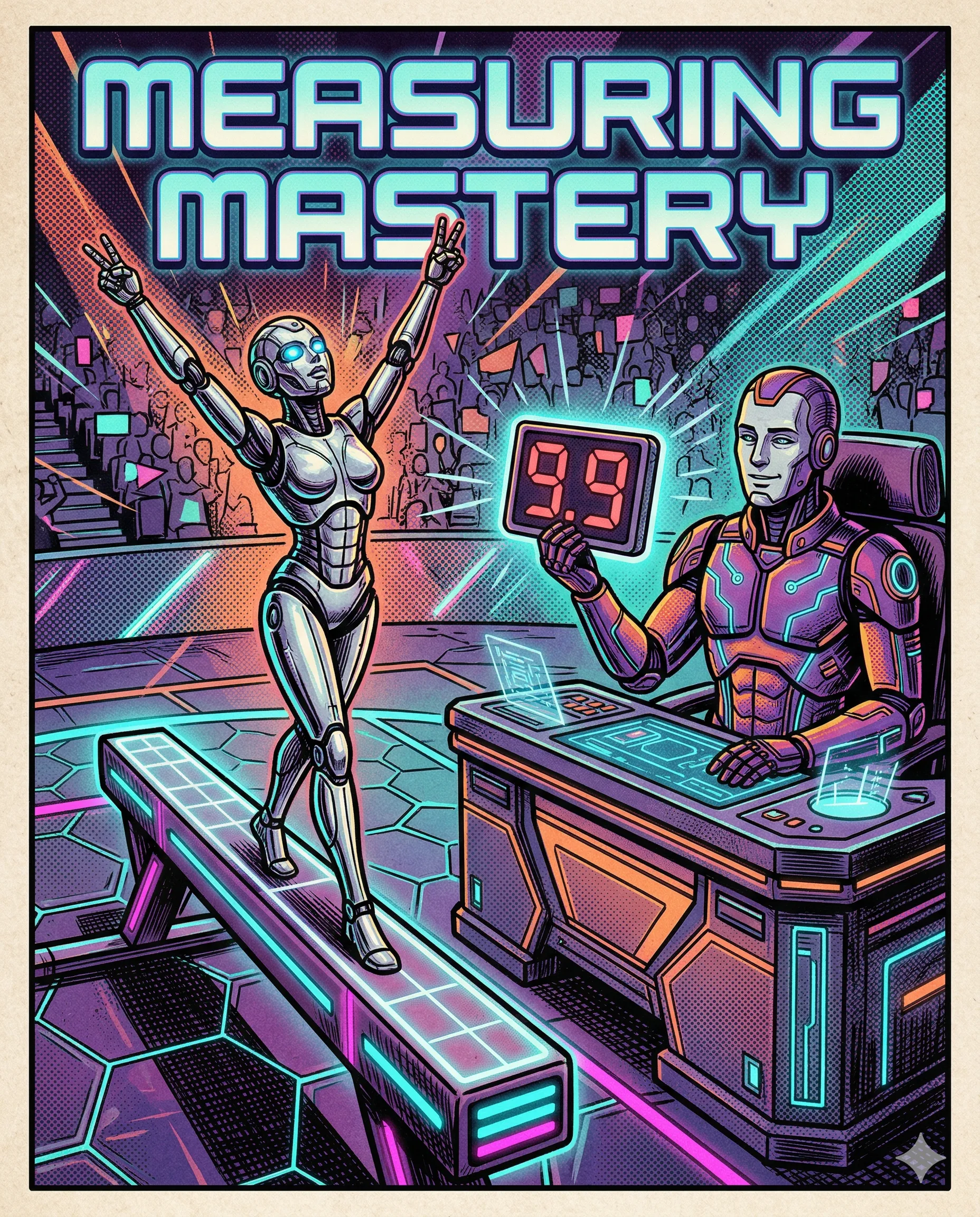
Imagine you are a judge at a high-level gymnastics competition. You are watching a robot perform a complex routine on the balance beam. To give a fair score, you don’t just look at whether the robot “finished” the walk. You have a specific scoreboard that measures three key things: Did the robot stay on the beam? Were its movements graceful? Did it follow the required sequence? This scoreboard turns a subjective performance into a precise, reliable number.
This precise scoring is exactly how we measure the success of an AI system.
When your AI answers a question, we need more than just a “feeling” that it worked. We use “Evaluation Metrics”—a digital scoreboard that tests every response. We measure things like “Faithfulness”—did the AI stick to the facts in the database? And “Relevance”—did the AI actually provide the specific information the user requested? This allows us to turn thousands of AI conversations into a single, clear score of 1 to 100.
The mechanism behind this is “Automated Evaluation.” Instead of having humans read every single answer, we use specialized algorithms to compare the AI’s response to the original source data. This creates a “Ground Truth” to measure against. If the AI adds a private detail or misses a key fact, the scoreboard instantly catches it. This ensures that every improvement you make to the system leads to a higher, more reliable score for your users.
In practice, this allows you to scale with complete confidence. For example, a travel company updates their AI to handle hotel bookings. By running an “Evaluation Suite” on 500 test questions, they see their “Accuracy Score” jump from 82% to 95%. They know the system is ready because the scoreboard proves it. The “Gymnastics Judge” stays focused on the technical perfection of every single move.
Success happens when the quality of your AI is a measurable fact. You transition from “testing by hand” to “scaling by the numbers.”
The Takeaway: a world-class AI system needs a scoreboard to prove that every answer is a perfect performance.
Why This Matters for Your AI Product
RAG Evaluation is the difference between guessing and knowing your system works:
- Avoid Content Regression: Every time you update your code or change your prompt, your scores might drop for specific user questions. Automation tells you before you ship.
- The Ragas Framework: Tools like Ragas or TruLens are the “gymnastics judges” for the industry. They provide standardized formulas for calculating Faithfulness and Relevance without human intervention.
- Moving to Production: No serious enterprise will deploy an AI system that doesn’t have a verifiable accuracy score. The metrics are your ticket to high-value contracts.
AI specialists call it: RAG Evaluation The process of using objective metrics to measure how well an AI retrieves information and how accurately it uses that information to answer questions.
If you were a judge for your own AI assistant, which one thing would you give the highest score for?
Part 16 of 18 | #RAGforHumans