Latent Diffusion: The Miniature Blueprint
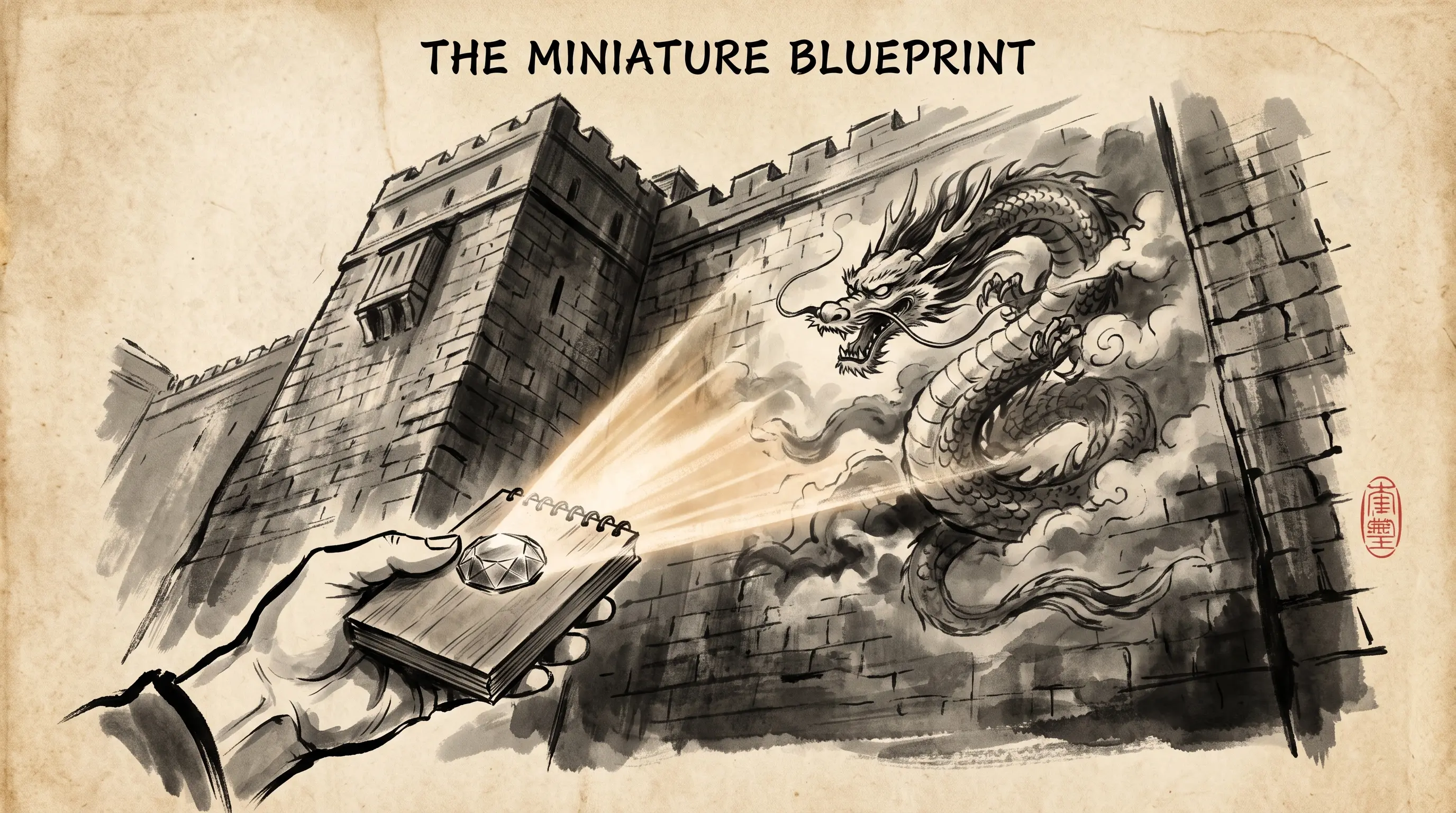
An artist is tasked with painting a massive mural across a castle wall, fifty feet wide. If he tried to run his step-by-step ink diffusion process across every single inch of the giant stone wall, it would take decades and an army of assistants.
Instead, he pulls out a miniature wooden pocket sketchpad from his robe, no bigger than the palm of his hand.
On this tiny pad, he runs his diffusion magic: dropping ink, pulling it back out, and quickly sculpting the composition—where the mountain goes, where the river bends, where the dragon flies. In seconds, he has the core essence of the entire painting captured in miniature.
Once the miniature blueprint is ready, he places a special crystal lens over the pad. The crystal projects and magnifies the miniature sketch directly onto the giant castle wall, expanding every detail and instantly filling in the textures with crisp, high-resolution clarity.
He didn’t do the heavy thinking on the massive wall. He did the hard work in miniature, where it was lightning fast.
The Reality
High-resolution images contain millions of individual pixels. Running 50 to 100 diffusion denoising steps directly on raw pixels requires monstrous computing power and massive amounts of memory. This is why early pixel-based diffusion models were painfully slow.
“Latent Diffusion” (the breakthrough behind Stable Diffusion) solved this problem.
Instead of working directly on pixels, the system uses an Autoencoder (VAE). An Encoder squashes the giant image down into a compact “latent space” (like the pocket sketchpad), making it 8 to 64 times smaller while preserving all the semantic meaning. The diffusion model then runs its noisy step-by-step magic entirely inside this compact space.
Once the denoising is complete, a Decoder expands and unpacks the latent representation back into millions of crisp pixels (like the magnifying crystal).
The Why
Latent Diffusion is what made modern Generative AI practical. By separating “creative reasoning” (done efficiently in latent space) from “pixel rendering” (done in a single final decoding step), image generation became fast enough to run on consumer graphics cards and personal laptops instead of industrial supercomputers.
The Takeaway
Solve the hard problem at the smallest possible scale before projecting it onto the real world.
AI specialists call it: Latent Diffusion Models (LDM) / Perceptual Compression
Instead of operating in high-dimensional pixel space x ∈ R^(H×W×3), an encoder E compresses the image into a lower-dimensional latent representation z = E(x). The diffusion and denoising processes occur entirely within this latent space z. Once denoised, a decoder D reconstructs the final image x' = D(z_0), dramatically reducing computational complexity while retaining high perceptual fidelity.
💬 Have you ever mapped out a big project on a napkin or sticky note first rather than diving straight into the final canvas?
Part 13 of 14 | #GenerativeModelsForHumans
#ai_edu Based on Stanford and industry lectures