Efficiency: Minimalist Rocketry
You just built the most powerful navigation system in the galaxy. It requires a dedicated mainframe the size of a cargo bay and draws enough power to dim the lights across the entire space station. The only problem is that you need to install it on a tiny, battery-powered courier drone.
If you try to force the giant system onto the drone as-is, it will drain the battery in seconds and crash. You have to make it efficient.
The Scenario
In the lab, you can run massive AI models on rows of expensive, power-hungry servers. But in the real world, you often need your AI to run on “the edge”—inside mobile phones, smart cameras, or low-power embedded chips.
You cannot afford to run a model that takes ten gigabytes of memory or requires a cooling fan just to process a single input. You need a way to shrink the brain without losing the intelligence.
The Reality
Deep learning engineers have three primary ways to compress a neural network so it runs on cheap, low-power hardware.
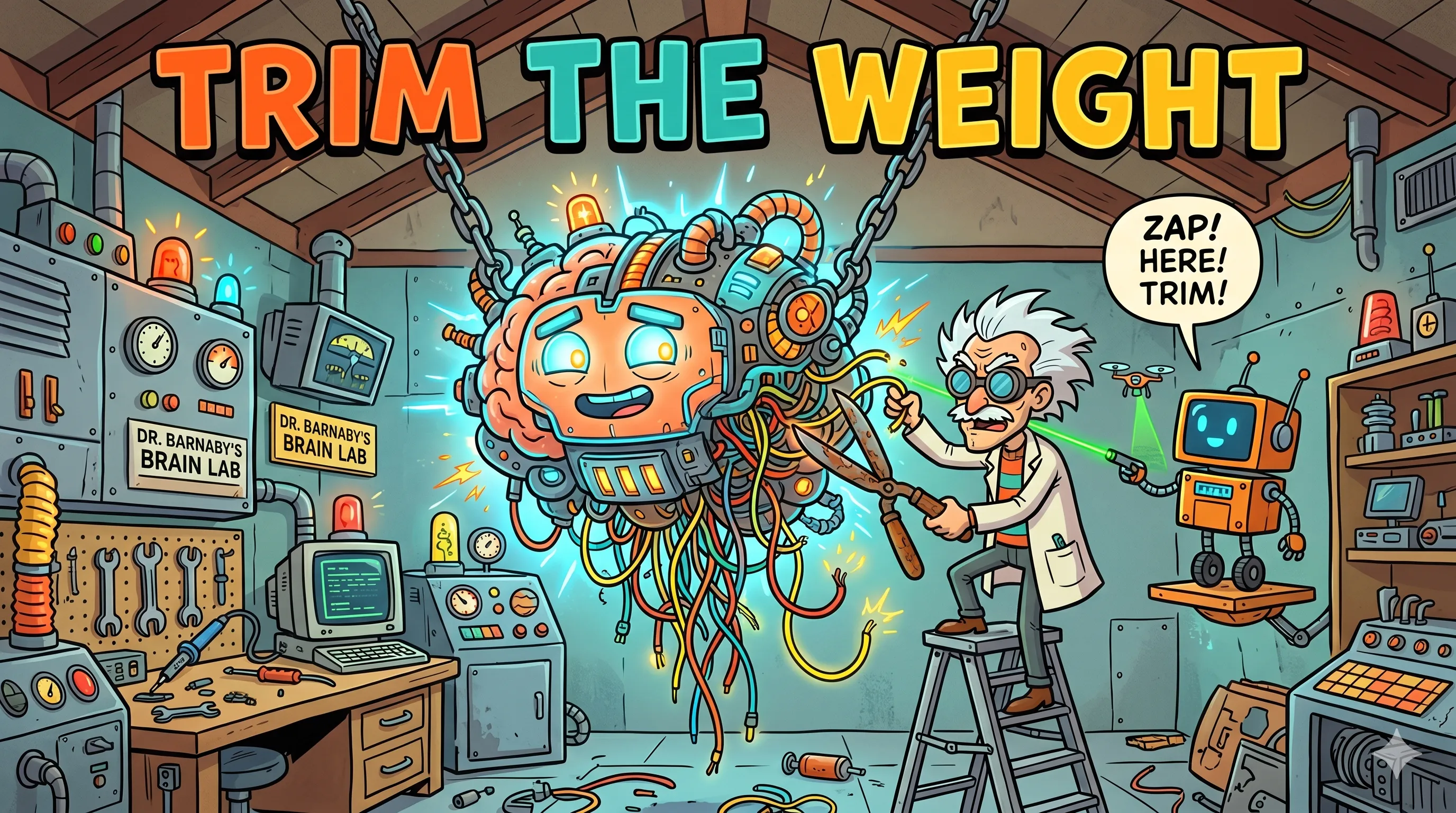
First, there is Pruning. You inspect the trained model and find the connections between neurons that rarely fire. If a weight is close to zero, it’s not doing any real work. You cut it. By removing these useless connections, you can often shrink the model’s size by 50% or more with virtually no loss in accuracy.
Second, there is Quantization. By default, computers store neural weights as highly precise 32-bit floating-point numbers. Quantization converts these numbers into simple 8-bit integers. It’s like replacing heavy titanium support beams with lighter alloy tubes. The model takes up a quarter of the space, runs much faster on cheap chips, and only loses a fraction of a percent in accuracy.
Third, there is Knowledge Distillation. You take your massive, highly accurate model (the Teacher) and use it to train a much smaller, lightweight model (the Student). The student doesn’t try to learn from the raw data; instead, it watches the teacher’s outputs and copies its decision-making style. The student ends up much smarter than it would have been if trained alone.
The Why
Deploying AI to the real world is a balance between accuracy, speed, and cost. By compressing your models, you can run them locally on the user’s device. This eliminates network latency, keeps user data private, and saves you thousands of dollars in cloud server bills.
The Takeaway
A model that is too big to run where your users are is a useless model. Trim the dead weight, simplify the math, and make your AI fit the hardware it has to live on.
AI specialists call it: Model Compression & Edge AI Deploying models to edge devices requires optimization. Pruning removes non-essential weights. Quantization reduces the numerical precision of weights (e.g., from FP32 to INT8). Knowledge Distillation uses a large “teacher” model to train a smaller “student” model to replicate its behavior, preserving performance at a fraction of the computational cost.
💬 Have you ever had to simplify a complex project just to make it fit a tight budget or limited timeframe? What did you cut?
Part 16 (Efficiency) of 20 | #DLLifecycleForHumans #ai_edu Based on CS230 Stanford lectures