The Control Panel: The Switches of Identity
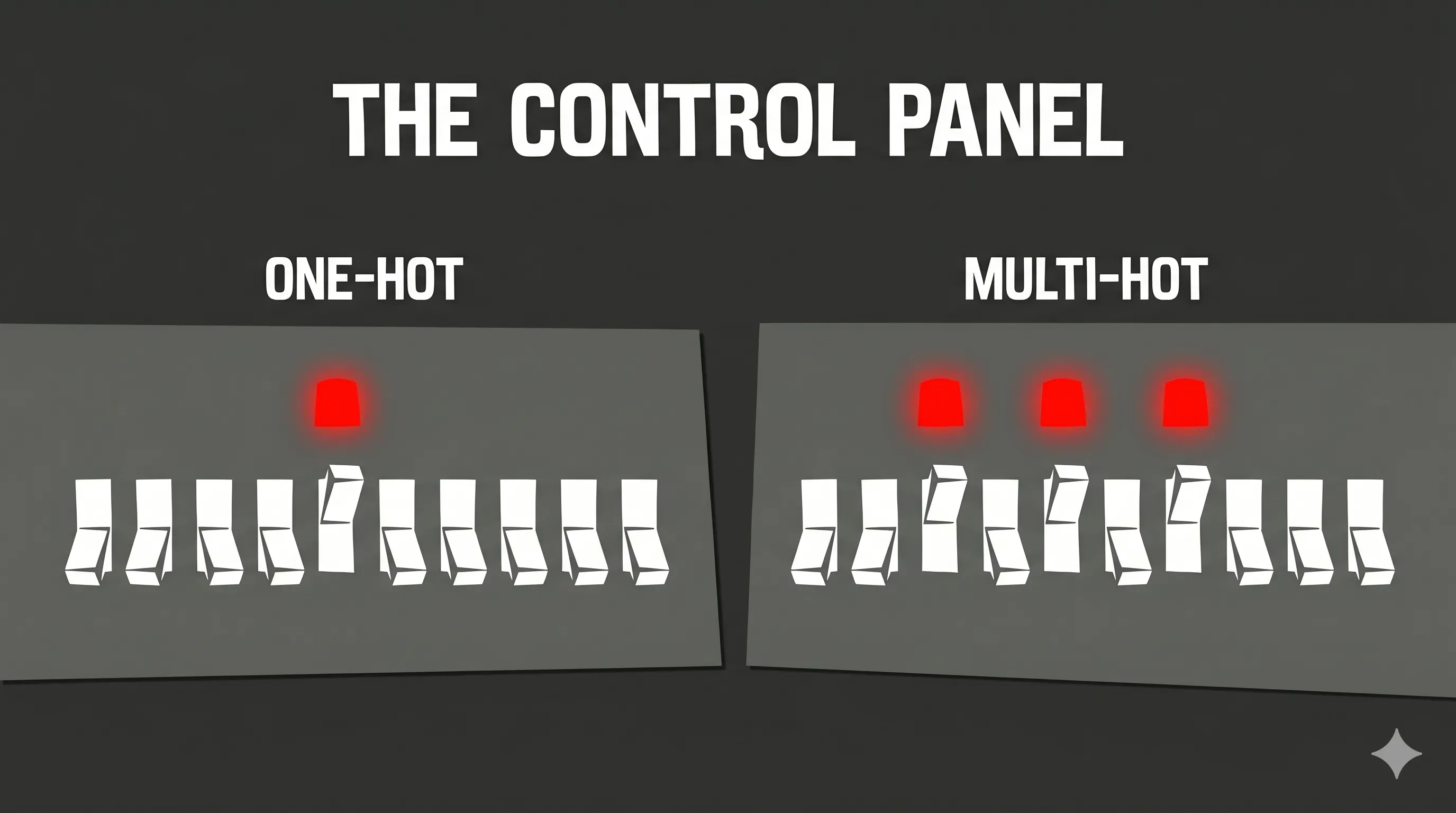
In the world of the machine, identity is not a name—it is a sequence of switches. To define who someone is, you must know which lights to turn on.
The Scenario
Imagine you are standing before a massive, brushed-steel control panel in a Cold War bunker. This panel defines every asset in your agency.
To describe an agent’s current location (One-Hot Encoding), you have a row of ten switches. Each switch represents a different city: London, Paris, Berlin, Moscow…
The rule of the machine is simple: only one light can be ON at a time. If the agent is in London, the first light glows red, and all others stay dark. You have a “One-Hot” vector. It is a precise, singular choice.
But what if you are describing an agent’s specialized skills (Multi-Hot Encoding)? You have another row of switches: Cryptography, Combat, Languages, Extraction…
Here, the rules change. An elite agent might be an expert in Cryptography and Languages. Now, two lights glow simultaneously. This “Multi-Hot” vector doesn’t just show a location; it shows a profile—a combination of traits that define a complex identity.
The Reality
In Deep Learning, we often need to tell the model about “categories.” If we are classifying fruits, a piece of data can usually only be one thing (Apple OR Orange)—we use One-Hot Encoding (a vector with a single 1 and many 0s).
But if we are tagging a movie with genres, it can be “Action” AND “Sci-Fi.” In that case, we use Multi-Hot Encoding (a vector with multiple 1s). These vectors are the way we turn “check-box” information into a format the neural network can process.
The Why
Neural networks are mathematical engines. They can’t process the word “London.” They need to see [1, 0, 0, 0, ...]. By turning categories into rows of switches (vectors), we allow the machine to calculate probabilities. It can say, “I am 90% sure the London switch should be ON.”
The Takeaway
One-hot is for “Pick one.” Multi-hot is for “Check all that apply.”
AI specialists call it: One-Hot Encoding / Multi-Hot Encoding One-hot encoding is a process of transforming categorical variables into a binary vector representation where only one element is high (1). Multi-hot encoding allows multiple elements to be high, representing multiple categories at once.
💬 If you had to control panel for your personality, which three switches would be permanently ON?
Part 15 (One-Hot vs Multi-Hot) of 25 | #DeepLearningForHumans