Rapid Acquisition: The Art of Data Smuggling
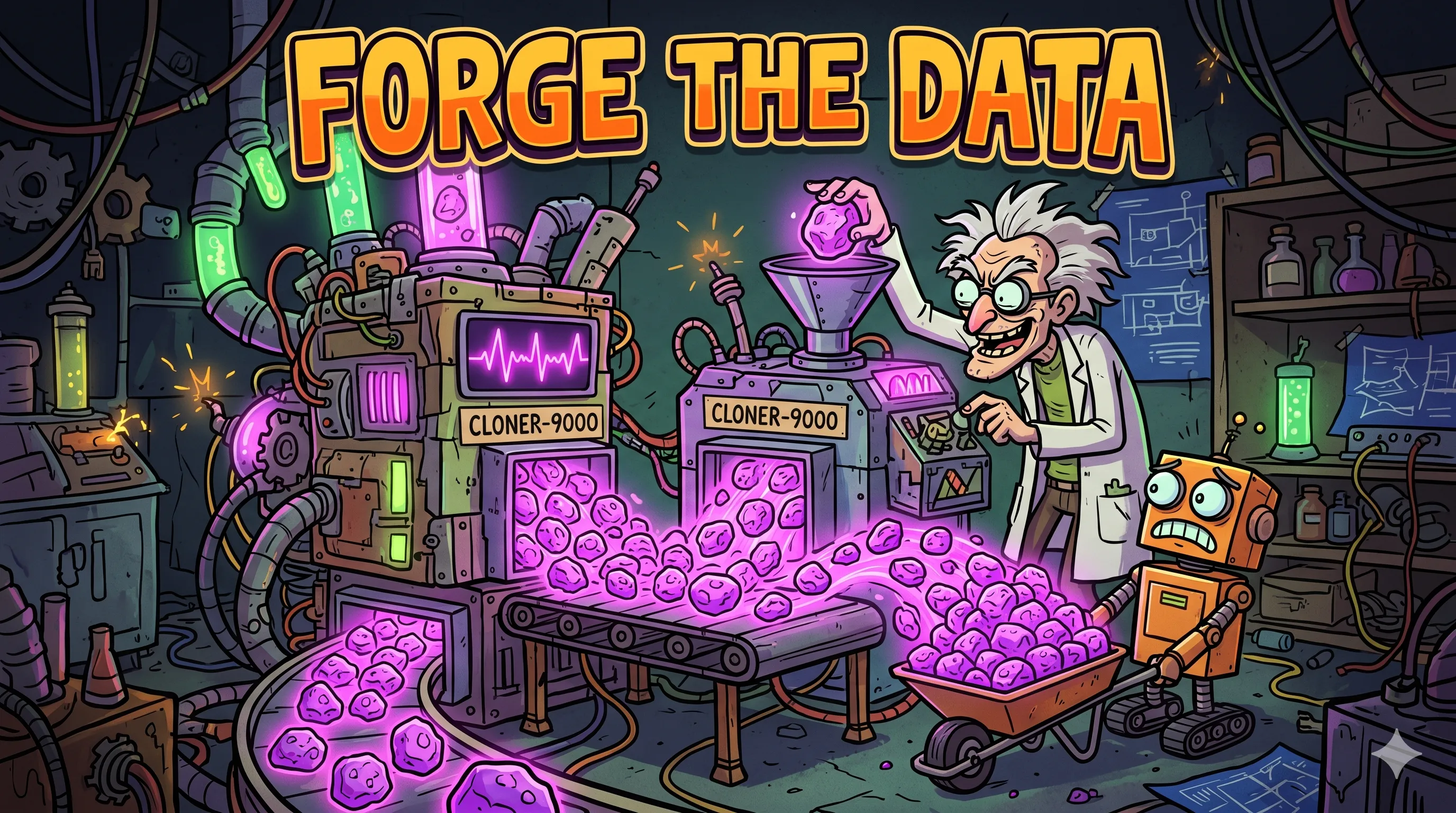
The diagnostics are clear: your engine fails whenever it encounters highly radioactive purple space dust. The problem? Purple space dust is incredibly rare. If you wait for your ships to naturally fly through it, it might take ten years to collect enough samples to train the engine.
You don’t have ten years. You need that dust today.
Welcome to Rapid Acquisition.
The Scenario
When you need a specific, rare type of cargo to study, you don’t just sit and wait. You hire smugglers. Or better yet, you buy a shady cloning machine, take the one spec of purple dust you have, and forge a million counterfeit copies of it. It doesn’t matter if it’s slightly illegal—as long as the engine learns how to handle it.
The Reality
In Deep Learning, this is called Data Synthesis and Data Augmentation.
When error analysis reveals a critical weakness in your AI, your immediate priority is to acquire data that targets that specific weakness. But you can’t always wait for real users to generate that data.
Instead, AI engineers “forge” the data. If the AI struggles with blurry images, they take their existing crystal-clear images and write a script to artificially blur them (Data Augmentation). If the AI struggles to recognize self-driving cars in the snow, they use video game engines to generate synthetic images of snowy roads (Data Synthesis).
The Why
Waiting for organic data to solve an edge-case problem is a luxury you cannot afford. To fix a specific vulnerability, you must flood the training simulator with exactly the right type of data. If you can’t find it in the real world, you manufacture it in the lab.
The Takeaway
Real data is great, but synthesized data is fast. When the AI has a blind spot, don’t wait for the world to provide the answer—forge it yourself.
AI specialists call it: Data Synthesis & Augmentation When a model struggles with a rare edge case, engineers artificially expand the dataset. Augmentation modifies existing data (e.g., rotating or blurring images), while Synthesis creates entirely new, artificial data points to simulate rare scenarios.
💬 Have you ever had to create a “fake” scenario to test a system because the real scenario was too rare or dangerous?
Part 13 (Rapid Acquisition) of 20 | #DLLifecycleForHumans #ai_edu Based on CS230 Stanford lectures