Diagnostics: Stop Twisting Dials Randomly
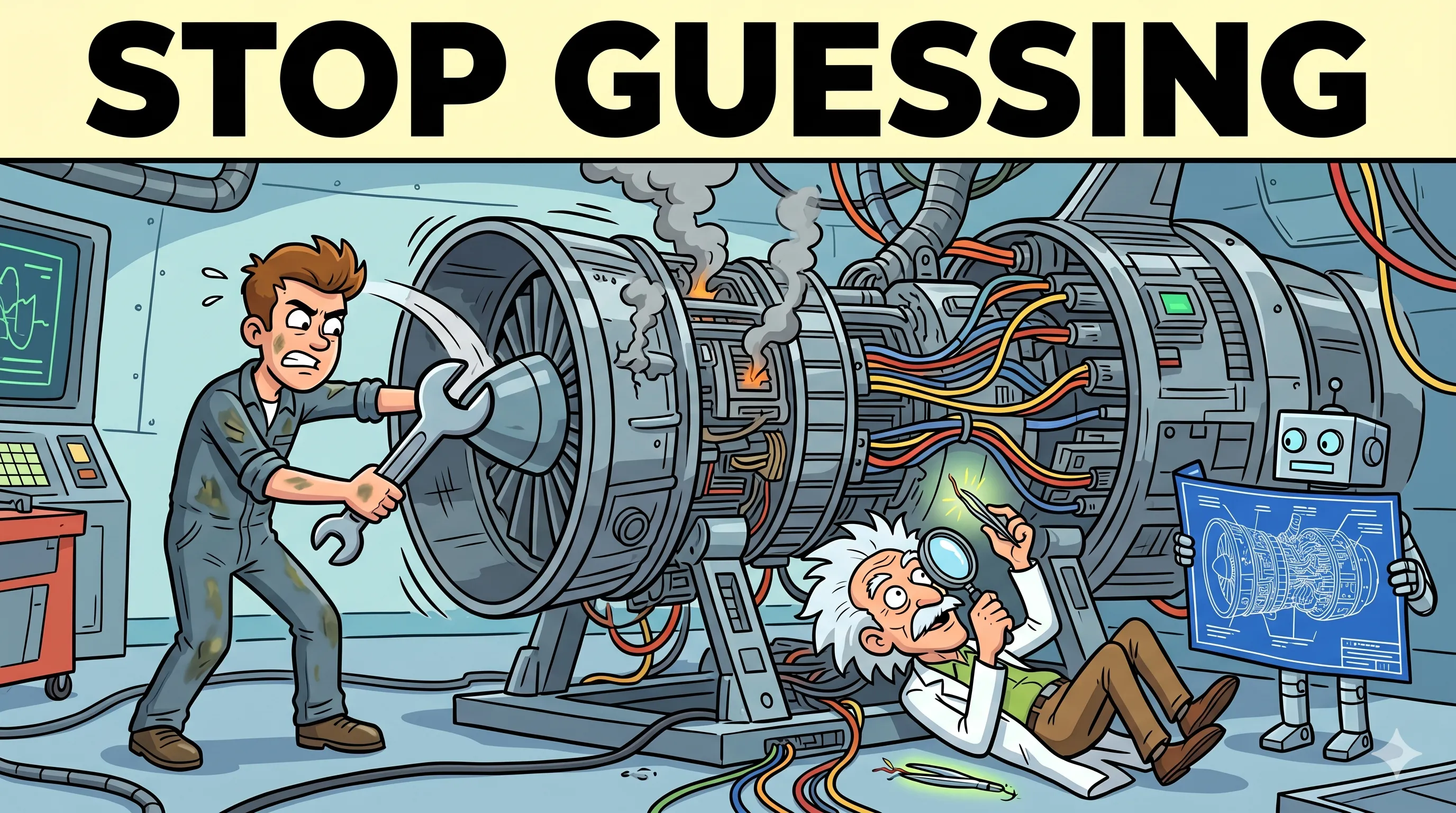
The engine is vibrating. The hyper-tube is feeding you data. You know something is wrong, but you don’t know what. So you grab a giant wrench and start hitting pipes at random, hoping the vibration stops.
Now the engine is on fire.
Welcome to Diagnostics.
The Scenario
When the delivery ship fails to dock properly, what exactly went wrong? Did the sensors fail to see the station? Did the steering thrusters ignore the command? Or did the pilot fall asleep?
If you don’t know the exact root cause of the failure, any “fix” you try to implement is just a blind guess. Twisting random dials might fix the docking issue, but it could also accidentally break the life support system.
The Reality
In Deep Learning, this is called Error Analysis or Orthogonalization.
When an AI model underperforms, inexperienced engineers will often just throw more data at it, add more layers to the neural network, or train it for longer. This is the equivalent of hitting the engine with a wrench.
Instead, professionals break the system down. They look at 100 specific examples where the AI failed and manually categorize them. Did it fail because the images were blurry? Because the text was in a different language? Because the object was partially hidden?
The Why
You cannot fix a system until you know which specific component is failing. If 80% of your AI’s errors are caused by blurry images, spending six months redesigning the core algorithm is a complete waste of time. You just need a better camera. Error analysis tells you where to invest your engineering time.
The Takeaway
Don’t optimize until you analyze. A week of random coding will save you an hour of manual error analysis—and ruin your product in the process.
AI specialists call it: Error Analysis & Orthogonalization This is the process of manually inspecting a model’s incorrect predictions to identify the specific root causes of failure, allowing engineers to tune distinct, independent components (orthogonalization) without breaking the rest of the system.
💬 Have you ever spent days trying to fix a complex problem, only to realize you were working on the completely wrong part of the system?
Part 12 (Diagnostics) of 20 | #DLLifecycleForHumans #ai_edu Based on CS230 Stanford lectures