Mode Collapse: The One-Trick Pony
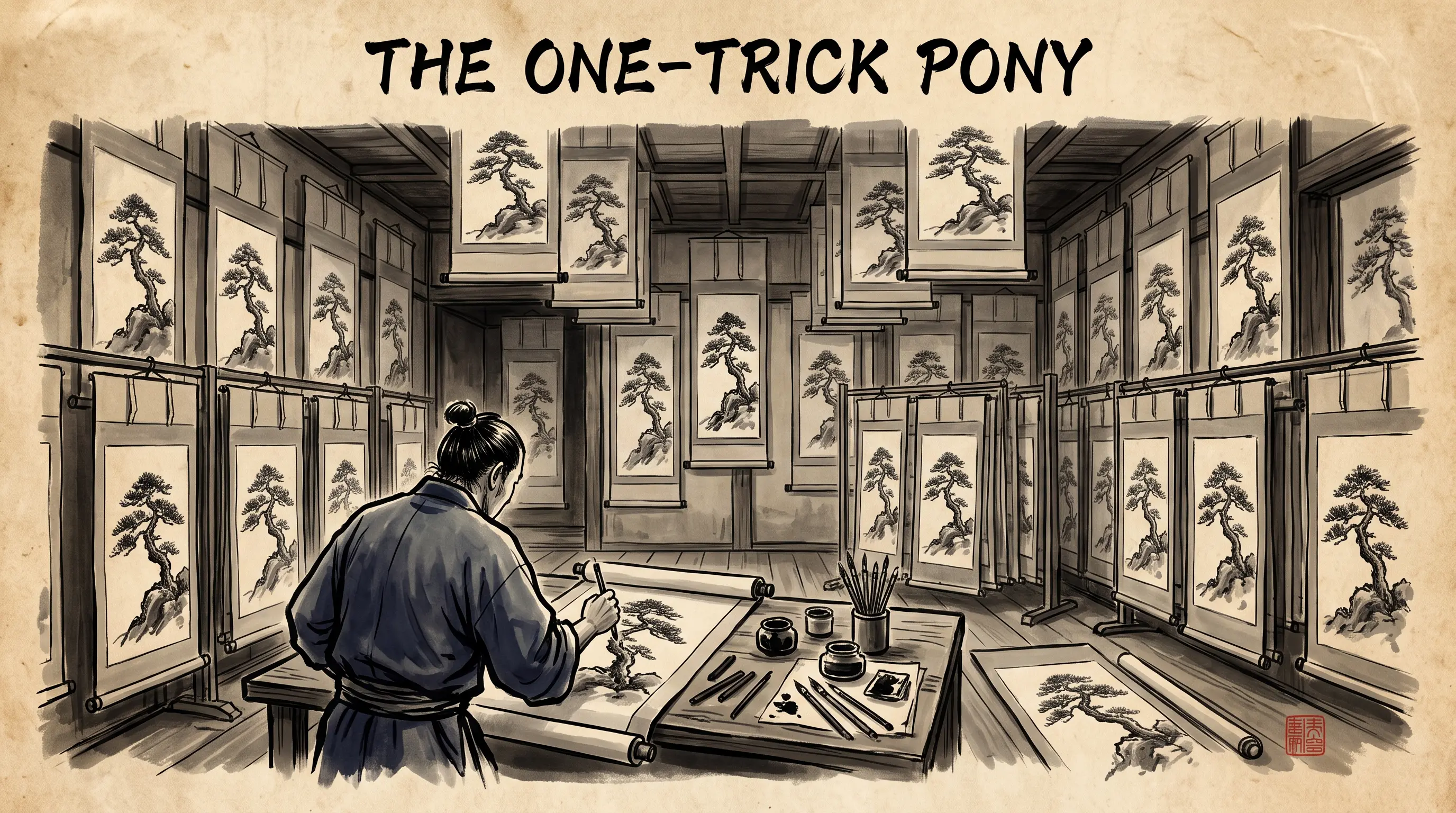
The art forger has been struggling in his duel with the Shogun’s inspector. The inspector keeps catching his fake landscapes, his fake mountains, and his fake rivers.
Then, one day, the forger paints a very specific pine tree. By sheer luck, it’s absolutely flawless. The inspector is completely fooled and stamps it “AUTHENTIC.”
The forger is thrilled. He wants to win again. So, what does he do? He paints the exact same pine tree. And again, the inspector is fooled.
Soon, the forger stops trying to paint mountains, rivers, or anything else. He realizes it’s much easier to just paint that one perfect pine tree over and over again. He has found a loophole in the game. But as a result, he ceases to be a master artist. He has become a one-trick pony.
The Reality
In Generative Adversarial Networks (GANs), this exact failure is called “Mode Collapse.”
A “mode” is just a cluster of similar data in a dataset (e.g., a dataset of faces has modes for people with glasses, people with hats, different skin tones, etc.). A good generative model should produce diverse outputs spanning all these modes.
However, the Generator’s only goal is to fool the Discriminator. Sometimes, the Generator discovers a specific type of output (one “mode”) that the Discriminator is currently bad at catching. Instead of learning the entire complex distribution of the real data, the Generator just collapses all its effort into producing that one single output over and over again, completely ignoring the rest of the dataset.
The Why
Mode collapse is one of the biggest headaches in training GANs. It highlights a critical flaw in the Minimax game: if you only incentivize the model to “win,” it will find the laziest, safest path to victory. It requires complex mathematical tweaks (like changing the loss functions, which we will cover next) to force the Generator to explore and produce diverse results, rather than just playing it safe.
The Takeaway
If you only reward someone for not making a mistake, they will only do the one thing they already know how to do perfectly.
AI specialists call it: Mode Collapse
Mode collapse occurs when the Generator fails to model the full diversity of the target data distribution, instead mapping multiple distinct latent vectors to a single, narrow subset of outputs (a single mode) because it is a highly confident local optimum for fooling the Discriminator.
💬 Have you ever noticed an AI tool giving you the exact same style of answer or image over and over again? What was it?
Part 7 of 14 | #GenerativeModelsForHumans
#ai_edu Based on Stanford and industry lectures