Self-Supervised Learning: The Autodidact Apprentice
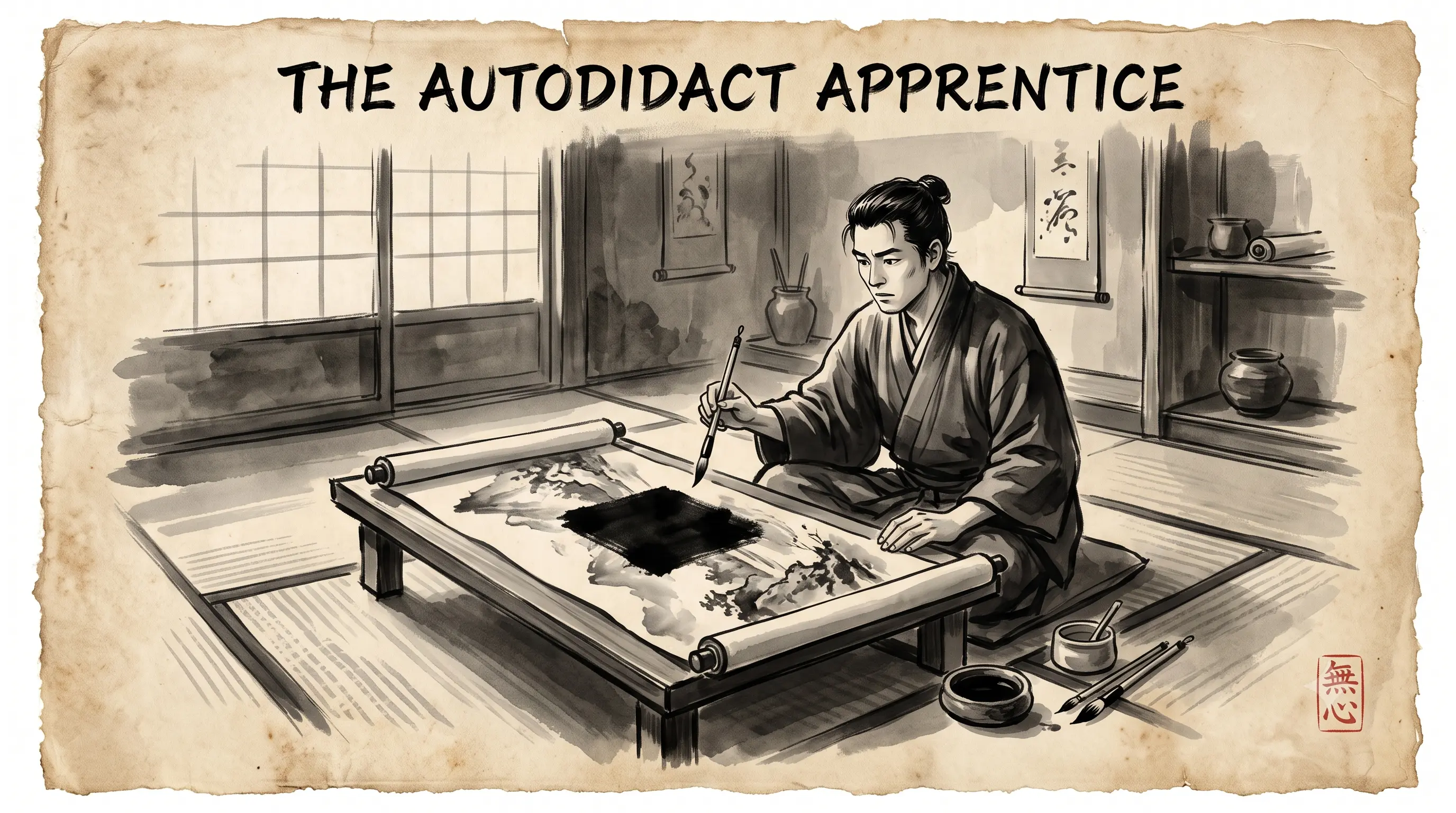
An apprentice artist wants to master the art of painting without a master watching over his shoulder. He takes a complete, beautiful scroll of a landscape. He drops a heavy splash of black ink over the middle of it, completely hiding a section of a mountain. Then, he takes his brush and tries to paint the missing piece from memory, attempting to make it blend perfectly with the rest of the scroll.
Once he finishes, he wipes away his own work to reveal the original painting underneath. He compares his attempt with the true masterpiece. If it’s wrong, he adjusts his technique. If it’s right, he moves on to hiding a different part of the scroll. He has become his own teacher.
The Reality
In machine learning, this is called Self-Supervised Learning.
Historically, AI needed humans to painstakingly label every piece of training data (e.g., “this is a mountain,” “this is a tree”). This is called Supervised Learning, and it is incredibly slow and expensive.
But generative models need to learn from the entire internet. We can’t label everything. Instead, we give the model a complete piece of data—like a sentence or an image—and artificially hide a part of it. The model’s job is to predict what is missing. The data itself provides the correct answer (the supervision).
The Why
This simple trick is the secret engine behind the modern AI boom. Because models can automatically evaluate their own guesses against the original hidden data, they can train on billions of unlabelled books, articles, and images without any human intervention. They learn the structure of human language and the physics of the real world entirely on their own.
The Takeaway
By hiding parts of the world and guessing what’s missing, AI becomes its own master.
AI specialists call it: Self-Supervised Learning (SSL)
SSL is a learning paradigm where models generate their own supervisory signal from unstructured data, typically by predicting masked or future parts of the input, eliminating the need for expensive human-annotated datasets.
💬 If you were forced to learn a completely new skill without a teacher, what “hide and guess” game would you play to teach yourself?
Part 3 of 14 | #GenerativeModelsForHumans
#ai_edu Based on Stanford and industry lectures