Delayed Gratification: The Greedy Frag vs. The Match Win
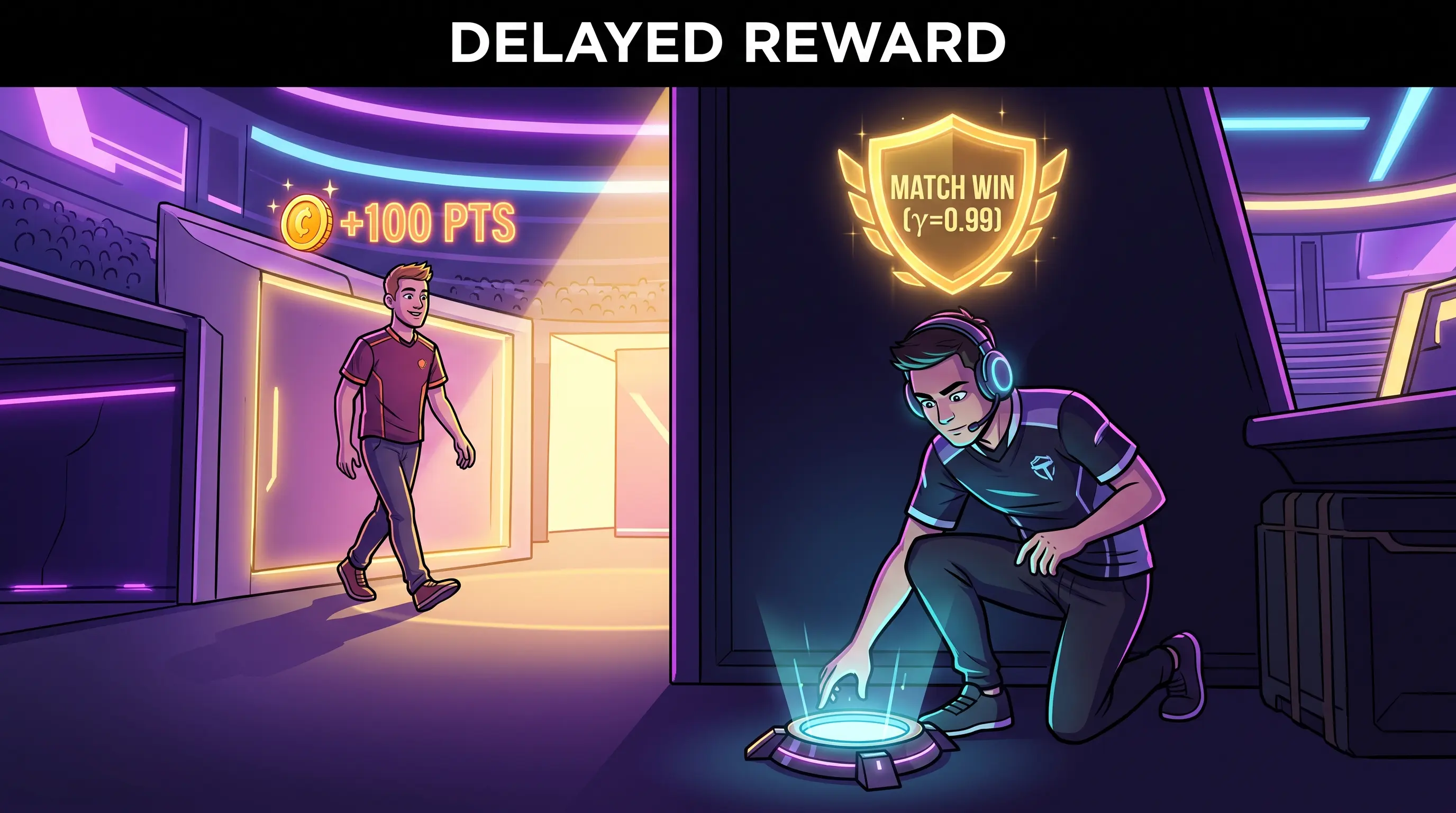
An amateur player in a tactical shooter tournament spots an enemy looking the other way.
His instincts scream for instant gratification: free kill, easy stat boost, immediate dopamine. He sprints forward, empties his magazine, and grabs the frag. The game gives him an instant +100 points on the scoreboard.
Ten seconds later, the round timer hits zero.
His team loses the round because nobody planted the bomb. Worse, by exposing his position for a meaningless frag, he got traded out, destroying his team’s economy for the next three rounds. He won a tiny battle and threw the war.
Now watch a seasoned pro in the exact same moment.
She spots the vulnerable enemy. Her crosshair is on him. But she doesn’t pull the trigger.
She lets him walk past into the shadows. She quietly slips onto the objective site, plants the spike with four seconds left on the clock, and anchors the site. She deliberately passed up an instant reward right now because she knew that securing the round victory ten seconds later was worth thirty times more.
The Reality
In Reinforcement Learning, this struggle between instant candy and long-term victory is governed by a single mathematical dial: the Discount Factor, written as the Greek letter Gamma ($\gamma$).
Gamma is a value between 0 and 1 that dictates how much the AI cares about the future compared to the present:
If Gamma is 0, the AI is completely short-sighted. It only cares about the reward landing right this microsecond. It will greedily hoard a penny right now, even if doing so drives it straight off a cliff one step later.
If Gamma is close to 1 (like 0.99), the AI becomes a patient strategist. Rewards waiting fifty steps down the road still hold massive value in its calculations today. It learns delayed gratification, tactical sacrifice, and long-term planning.
Every reward that lies in the future is multiplied by Gamma for every step of distance. A prize one step away is worth $\gamma$ times its value. A prize two steps away is worth $\gamma^2$. If Gamma is high enough, the future stays bright; if Gamma is low, the future fades to black.
The Why
Real-world intelligence rarely hands you points immediately for doing the right thing.
Sacrificing a piece in chess, saving money for an investment, braking before a sharp turn, or planting a bomb in an arena shooter all feel like zero reward—or even a setback—in the immediate second. Without a discount factor that values the future, an AI agent will always turn into a short-sighted gremlin: picking up loose pennies on the ground while its headquarters burns down.
The Takeaway
Amateurs play for the score of the current second; champions play for the score at the final whistle.
AI specialists call it: Discount Factor ($\gamma$) / Cumulative Discounted Return
The expected return G_t is defined as the discounted sum of future rewards: G_t = r_(t+1) + γ r_(t+2) + γ^2 r_(t+3) + ... = Σ γ^k r_(t+k+1). The parameter γ ∈ [0, 1) prevents infinite return loops in non-terminating tasks and mathematically balances immediate greedy exploitation against delayed strategic planning.
💬 Have you ever made a decision that hurt your immediate score or comfort, but paid off massively months or years down the line?
Part 3 of 15 | #ReinforcementLearningForHumans
#ai_edu Based on Stanford and industry lectures