Adversarial Examples: The Painted Calavera
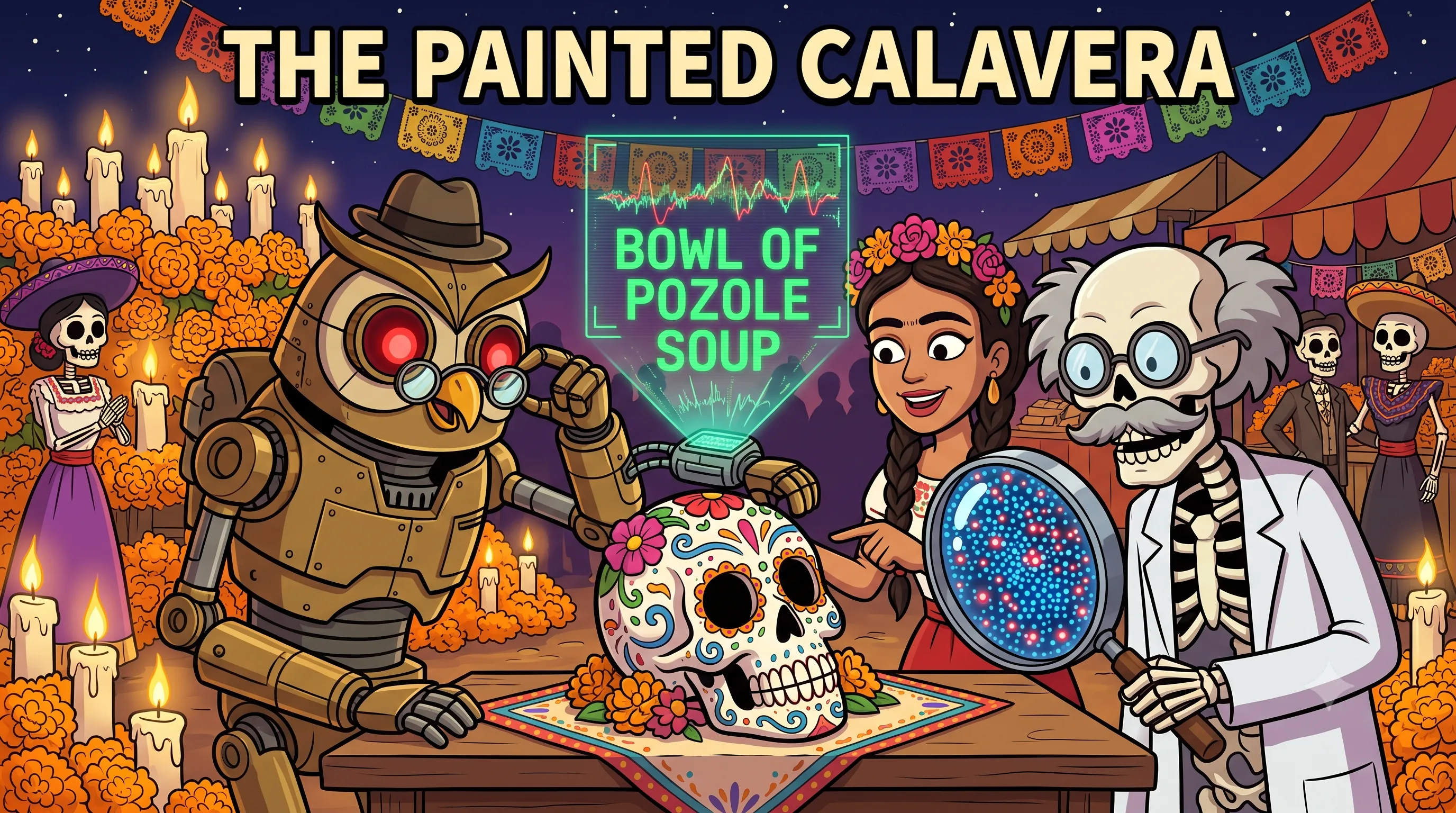
A skeleton candy-maker wants to smuggle a festive sugar skull past the strict cemetery tax inspector. The inspector is a robotic owl trained to identify cargo. To a human eye, the sugar skull looks completely normal. But the candy-maker has painted microscopic, sub-visual patterns of blue and red dots on the skull’s forehead. The moment the robotic owl scans it, the patterns confuse its sensors, and the owl confidently logs the cargo as a “Bowl of Hot Pozole Soup.”
The owl didn’t malfunction. Its vision was hijacked by a calculated optical illusion.
The Scenario
When we look at a picture, we see shapes, colors, and contexts. When a neural network looks at a picture, it sees a massive grid of numbers (pixel values).
Because of this, neural networks do not see things the way we do. They are highly sensitive to microscopic patterns.
The Reality
This sensitivity creates the vulnerability of Adversarial Examples.
An attacker takes a normal image (like a stop sign) and calculates a pattern of tiny, sub-visual changes — called a perturbation. To a human, the image is completely unchanged. But when the model processes the pixels, the calculated noise shifts the mathematical boundaries in its brain. The model confidently classifies the stop sign as a “speed limit 100” sign. This isn’t random guesswork; the attacker has mathematically optimized the noise to trigger a specific error.
The Defense
To protect your vision models from being blinded by calculated noise, use these tactics:
- Adversarial Training: Train your model on both clean images and adversarial examples. By forcing the model to classify noisy images correctly during training, it learns to ignore the sub-visual patterns.
- Pre-input Denoising: Run your input images through a preprocessing filter (like Gaussian smoothing or JPEG compression) before feeding them to the model. This simple step blurs and destroys the precise sub-visual patterns the attacker calculated.
The Takeaway
A tiny pinch of math can make a neural network see a bowl of soup where a human sees a skull. Never assume your AI sees the same world you do.
AI specialists call it: Adversarial Examples & Small Perturbations Adversarial examples are inputs to a machine learning model that have been intentionally modified with small, sub-visual perturbations to cause the model to make a mistake. Attackers calculate these perturbations using optimization algorithms. Defenses include adversarial training (training on perturbed data) and input preprocessing to destroy the malicious noise patterns.
💬 Have you ever experienced a visual illusion that completely tricked your brain, even after you knew how it worked? What was it?
Part 3 (Adversarial Examples) of 8 | #AdversarialRobustnessForHumans #ai_edu Based on industry security research