The Core RL Loop: The Four-Step Dance of the Pro Gamer
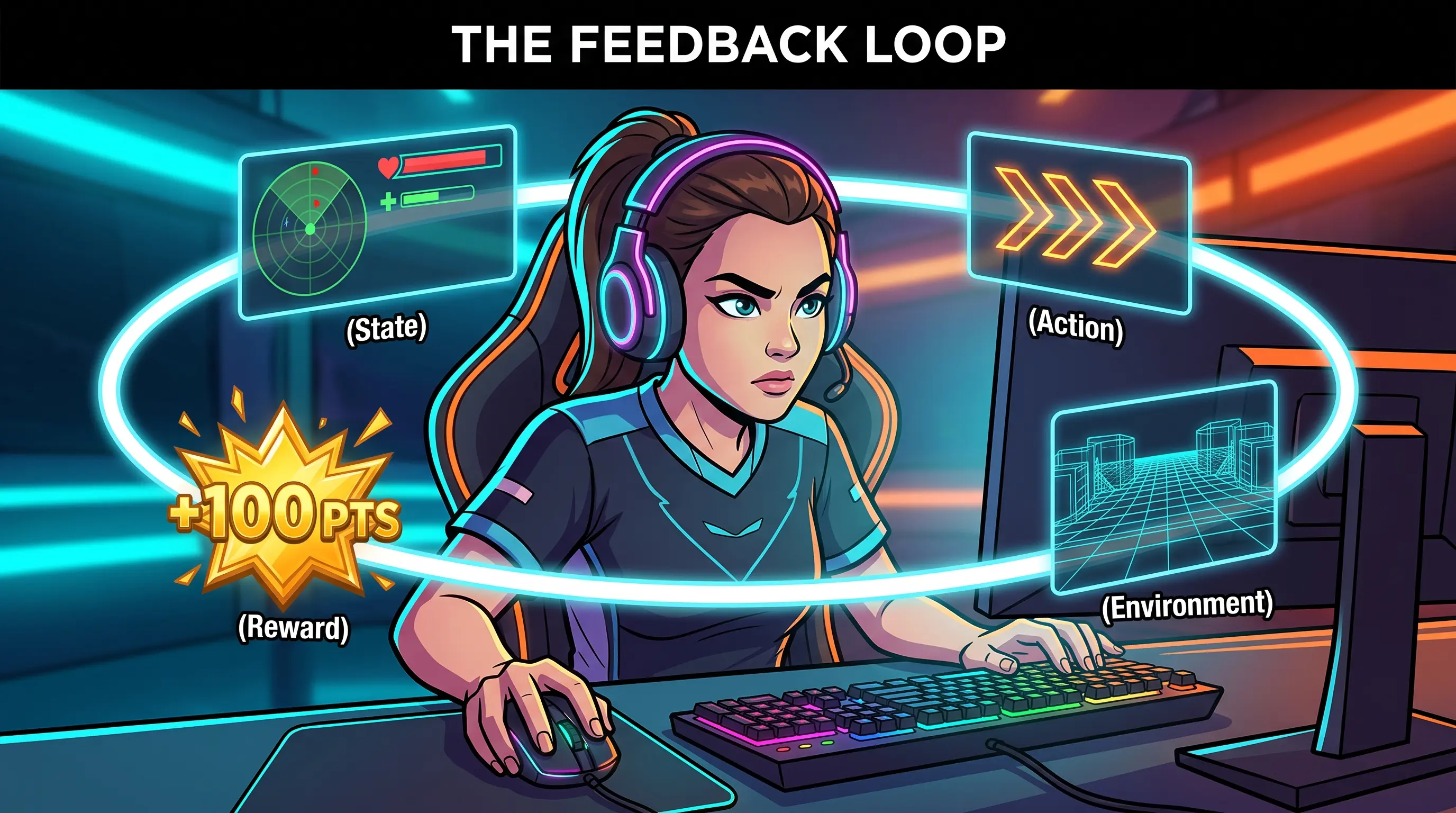
Watch a pro esports player in the final five seconds of an impossible 1v1 clutch.
She isn’t staring at her fingers or pondering abstract game theory. Her nervous system is locked into a lightning-fast, unbroken cycle running sixty times every single second.
First comes the snapshot: her eyes scan the monitor. Fourteen health points remaining, two bullets in the magazine, enemy footsteps splashing through the water to her left. That is her State.
Instantly, her reflexes trigger. She flicks her wrist, slides behind a metal crate, and pre-fires the corridor. That is her Action, chosen by her instinct—her Policy.
The game engine registers her input, recalculates physics, and resolves the bullet trajectory. That is the Environment.
A split-second later, the feedback lands: a sharp metallic ding, the enemy drops, and the crowd roars. That is her Reward.
Had she peeked half a second later, the feedback would have been a red screen flash, a death animation, and a painful loss.
The Reality
Every reinforcement learning system—from the AI that crushed human champions at Dota 2 to robotic arms learning how to fold laundry—runs on this exact cycle. It is known as the Reinforcement Learning Loop (formally framed as a Markov Decision Process).
The cycle has five moving parts:
- The Agent: The AI player sitting in the driver’s seat.
- The Environment: The world the agent lives in (a game engine, a factory floor, or the stock market).
- The State ($s_t$): The current situation—everything the agent observes right now.
- The Action ($a_t$): What the agent decides to do based on its current observation.
- The Reward ($r_t$): The immediate score handed back by the environment (+100 for winning a round, -50 for taking damage, 0 for safe repositioning).
Binding it all together is the Policy ($\pi$): the internal strategy manual that dictates which action to pick when facing any given state.
The Why
Traditional software tells a computer: “If X happens, run step Y.” Supervised learning tells a computer: “Here is what a human expert did when X happened.”
The reinforcement learning loop does something fundamentally different: it gives the machine agency. The AI takes an action, the world changes in response, and the environment delivers immediate numerical feedback. The agent isn’t a passive calculator processing static data; it is an active participant learning through real-time cause and effect.
The Takeaway
Intelligence is not a library of static knowledge; it is an unbroken loop of observing, acting, and adapting to consequences.
AI specialists call it: Markov Decision Process (MDP) / Agent-Environment Loop
At each discrete timestep t, the agent observes state s_t ∈ S, receives scalar reward r_t ∈ R, and selects an action a_t ~ π(a|s_t). The environment transitions to s_{t+1} ~ P(s'|s_t, a_t) and emits reward r_{t+1}. The agent’s objective is finding an optimal policy π* that maximizes expected cumulative discounted return G_t = Σ γ^k r_{t+k+1}.
💬 Think of the hardest video game or sport you’ve ever played. How long did it take before the feedback loop shifted from conscious panic into pure instinct?
Part 2 of 15 | #ReinforcementLearningForHumans
#ai_edu Based on Stanford and industry lectures