Cosmic Fuel: Why Data Quality is Your Only Hope
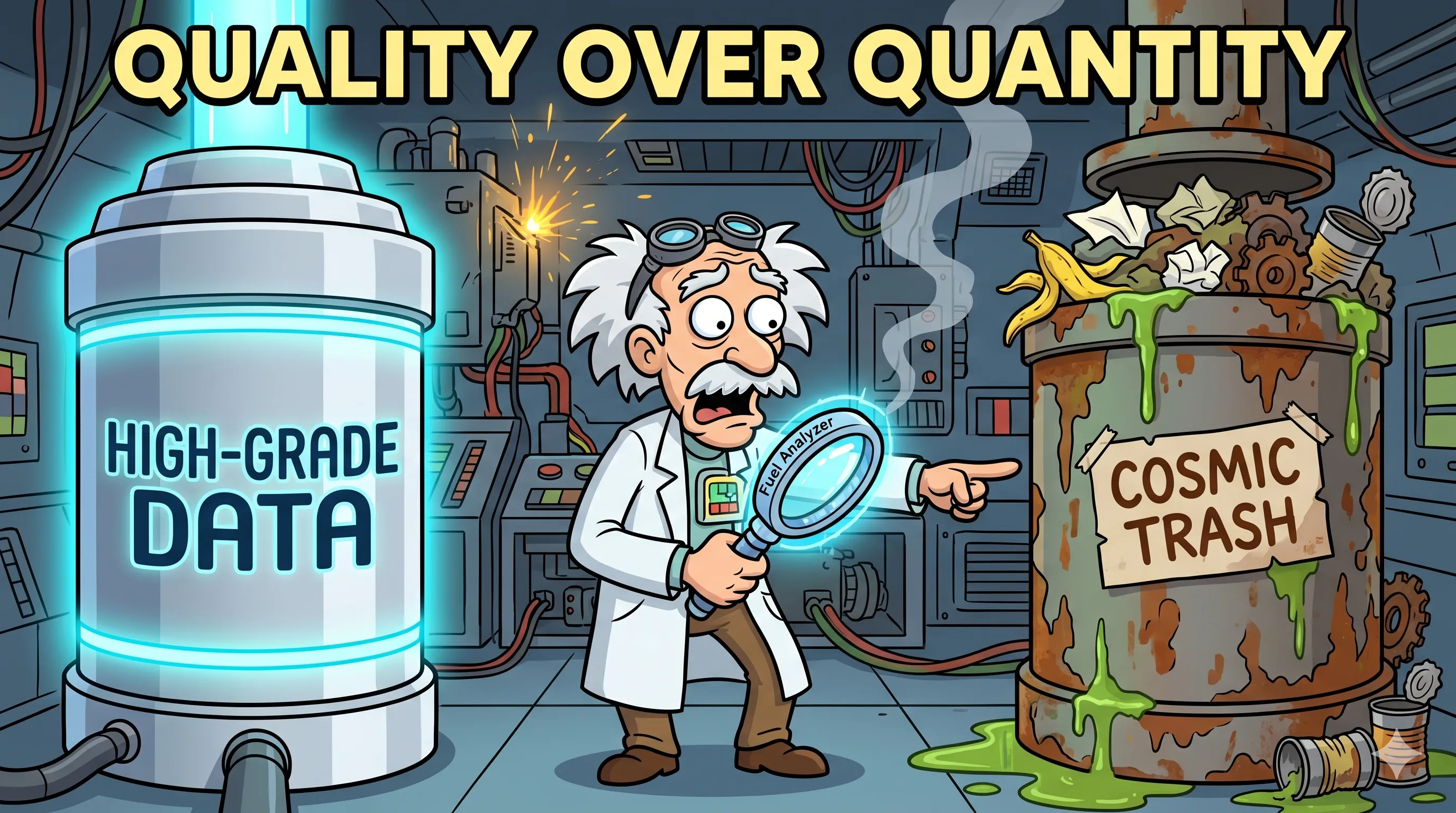
We have a massive problem. I’ve optimized our star-ship’s engine to reach Warp 10 using a sophisticated neural navigator. It’s a masterpiece of engineering. But there’s one tiny issue… every time we turn it on, the ship tries to fly directly into the nearest supernova.
The Scenario
It turns out our procurement droid was trying to save credits. Instead of buying “High-Grade Stellar Navigation Maps,” it bought a collection of “Napkin Sketches by Lost Tourists” from a vendor at a moon-base bar.
The engine (the model) is working perfectly. The turbines (the code) are spinning faster than ever. But because the input (the data) is garbage, the output is a death sentence.
In AI, Data Quality is the only thing that stands between a breakthrough and a spectacular explosion in the middle of a nebula.
The Reality
We used to think “Big Data” was the magic word. “Just throw more data at it!” we shouted while dumping terabytes of noise into the system. But the universe doesn’t work that way.
A small, high-quality dataset of 1,000 “clean” examples (accurate, diverse, and well-labeled) is often 10x more powerful than a “dirty” dataset of 1,000,000 examples. If your training data has errors—like mislabeled images or biased text—your model won’t know they are mistakes. It will learn them as the fundamental laws of physics.
The Why
In the AI lifecycle, the first thing you do when your model fails isn’t to “get more data.” It’s to look at the data you already have.
- Is it accurately labeled?
- Does it represent the real environment the ship will fly in?
- Is it “clean,” or is it full of tourist napkins?
Data cleaning isn’t just a chore; it’s the most important engineering task in the entire mission.
The Takeaway
In AI, the quality of your data is the ceiling of your model’s performance. You can’t reach the edge of the galaxy on a tank full of cosmic trash.
AI specialists call it: Data Labeling & Cleaning Data cleaning is the process of identifying and correcting errors, inconsistencies, and inaccuracies in a dataset to ensure the highest quality input for model training.
💬 If you had to throw away 90% of your data but keep the most “accurate” 10%, how would you even know which pieces are the tourist napkins?
Part 2 (Quality of Data) of 20 | #DLLifecycleForHumans #ai_edu Based on CS230 Stanford lectures