Learning Data Distributions: The Mathematics of Essence
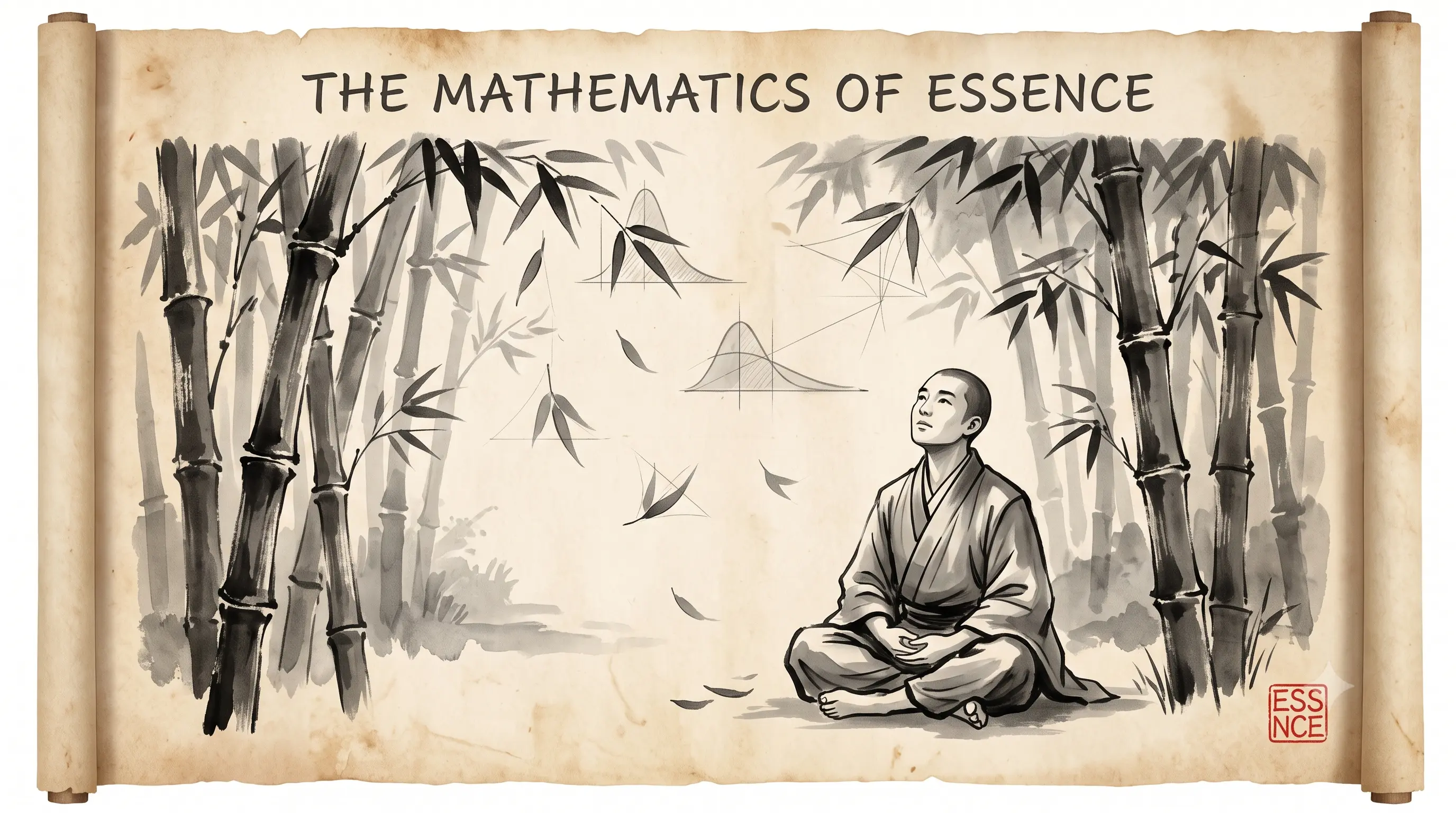
A young apprentice sits silently in a bamboo forest. He holds no brush and no ink. For months, he simply observes. He notices that eight out of ten bamboo leaves curve slightly downward, while two curve sharply. He realizes the stalks are never perfectly straight, and the spaces between them follow an invisible rhythm. He is not memorizing one specific stalk of bamboo. He is learning the underlying rules of how bamboo exists in the world.
When he finally returns to his studio to paint, he doesn’t paint the exact bamboo he saw. He paints a completely new stalk that follows the exact same invisible rules.
The Reality
This is exactly what happens when you train a generative AI model.
In machine learning, this process is called “learning the data distribution.” A distribution is just a massive mathematical map of probabilities. When you feed an AI millions of pictures of human faces, it doesn’t store those photos in a database like a digital scrapbook.
Instead, it acts like the apprentice. It learns the probabilities of the dataset. It learns that eyes are always above noses, that certain shadows naturally follow specific jawlines, and that a face with three eyes has a probability of exactly zero.
The Why
If an AI simply memorized its training data, it would be useless—it could only spit out exact copies of what it had already seen. That’s just a search engine.
By learning the mathematical distribution instead, the model understands the essence of the data. This allows it to do something magical: “sampling.” It can pull a new set of data points from that probability map to generate a face, a song, or a line of code that has never existed before, but perfectly obeys the rules of reality.
The Takeaway
Generative models don’t memorize the world; they learn the mathematical probability of its essence.
AI specialists call it: Learning Data Distributions
Instead of storing explicit examples, generative models learn the underlying probability density function (PDF) of the training data, allowing them to draw novel samples from regions of high probability.
💬 If you had to describe the “data distribution” of your own writing style, what invisible rules would an AI notice?
Part 2 of 14 | #GenerativeModelsForHumans
#ai_edu Based on Stanford and industry lectures