Supervised vs. Reinforcement Learning: Trial by Fire
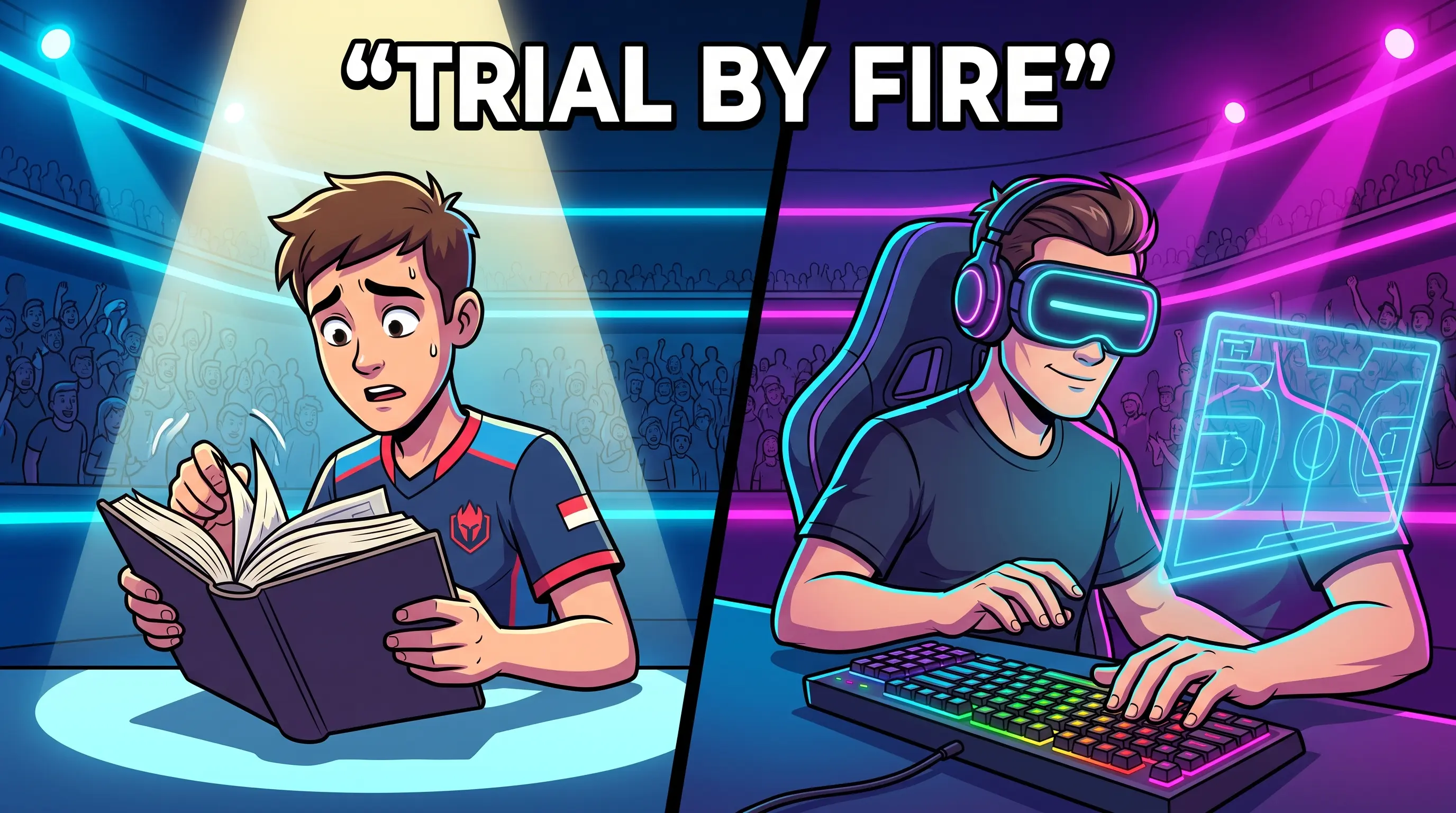
A rookie esports player sits in the tournament booth, clutching a massive 500-page strategy guide. He has memorized every classic opening move, every standard counter, and every textbook combo from the last five years of championship replays.
Three minutes into the match, his veteran opponent pulls off a bizarre, unorthodox flank that has never appeared in any tournament broadcast.
The rookie freezes. The move isn’t in his textbook. He has no pre-labeled “correct answer” to copy. Within seconds, his base is wiped out.
Across the stage, the veteran didn’t study flashcards. She learned how to play by logging ten thousand grueling matches. She lost thousands of rounds, tested weird ideas, felt the sting of every mistake, and discovered winning strategies that no book had ever written down.
The Reality
Most AI systems you interact with are trained via Supervised Learning. A human teacher hands the model millions of labeled flashcards: “Here is a photo, the answer is Cat. Here is an email, the answer is Spam.” The model learns by memorizing and matching patterns.
Supervised learning works wonders when you have clear labels. But in complex environments—like chess, StarCraft, self-driving cars, or negotiations—there is no teacher standing by to hand you the “perfect move” for every trillionth of a second.
This is where Reinforcement Learning (RL) takes over.
In RL, there is no teacher and no dataset of correct answers. The AI is simply dropped into the arena with a goal (win the game, stay on the road, maximize points) and a set of controls. It tries an action, observes the result, gets rewarded or punished, and gradually learns the optimal strategy through pure trial, error, and consequences.
The Why
Supervised learning teaches an AI to imitate the past. Reinforcement learning teaches an AI to invent the future. It is the exact reason AlphaGo was able to discover “Move 37”—a move no human had played in three thousand years of Go history, because the AI wasn’t trained to copy human games; it was trained to win.
The Takeaway
Memorizing past answers teaches you how to copy; learning through consequences teaches you how to win.
AI specialists call it: Supervised Learning vs. Markov Decision Process (MDP) / Reinforcement Learning
Supervised learning optimizes a loss function against ground-truth labels y given input x (L(f(x), y)). Reinforcement learning optimizes a policy π(a|s) to maximize expected cumulative future reward E[Σ γ^t r_t] through direct interaction with an environment, without requiring explicit step-by-step supervision.
💬 Have you ever tried to learn a new skill from a book, only to realize you learned 10x faster the moment you made your first real mistake in practice?
Part 1 of 15 | #ReinforcementLearningForHumans
#ai_edu Based on Stanford and industry lectures